News
Veterinary Student Explores Clinical Applications For Equine Medical Research
Story by Courtney Price, VMBS Marketing & Communications
When third-year Doctor of Veterinary Medicine (DVM) student Alexandra Aucoin began her journey toward equine medicine, she didn’t think that research would ever play a major role.
However, after an opportunity to work in the Texas A&M Equine Infectious Disease Laboratory (EIDL) through the Texas A&M College of Veterinary Medicine & Biomedical Sciences’ Veterinary Medical Scientist Research Training Program (VMSRTP), Aucoin has not only developed a new excitement for research but has also already made an important contribution to the study of foal pneumonia.
Developing A Passion For Equine Medicine
Aucoin has been an equestrian since a young age, even riding hunter-jumper on the show circuit. The experience helped cement her decision to become a veterinarian.
“My high school didn’t offer a veterinary education program, so I actually did a two-year nursing program instead,” she said. “That helped me realize that I love medicine, but I prefer working with animals over people.”
When it came time to choose a college with a strong track record for helping pre-vet students, Aucoin chose Texas A&M University because of its welcoming community and opportunities to get hands-on experience.
“At a lot of other schools I considered, the DVM program is kept very separate from the undergrad program,” she said. “You don’t really get a chance to visit the (veterinary teaching) hospital as an undergrad, but that’s not the case here at Texas A&M. It’s much more integrative thanks to student worker opportunities, and you can tell they want to show you the world of veterinary medicine.”
Initially, Aucoin was interested in becoming an equine surgeon because of her experience working in the Equine Surgery Ward at the Texas A&M Large Animal Teaching Hospital.
“I was really impressed by the soft tissue and orthopedic surgery teams and I loved anatomy,” she said. “I’m really good at working with my hands and I loved how immediately you get to see the results of the problem-solving that you do in surgery.”
There was only one drawback to this potential career path.
“I wasn’t sure if I wanted to spend six-to-eight hours in an operating room,” she said. “I met Dr. Noah Cohen, who became my faculty mentor, and he let me know about the Hagyard Equine Medical Institute in Lexington, Kentucky, so I completed a six-month internship there during my junior year of college. I spent most of my time in the neonatal intensive care unit, where you still get to do a lot of problem-solving. That’s when I realized that what I really wanted to do was equine internal medicine.”
Taking Chances, Finding Success
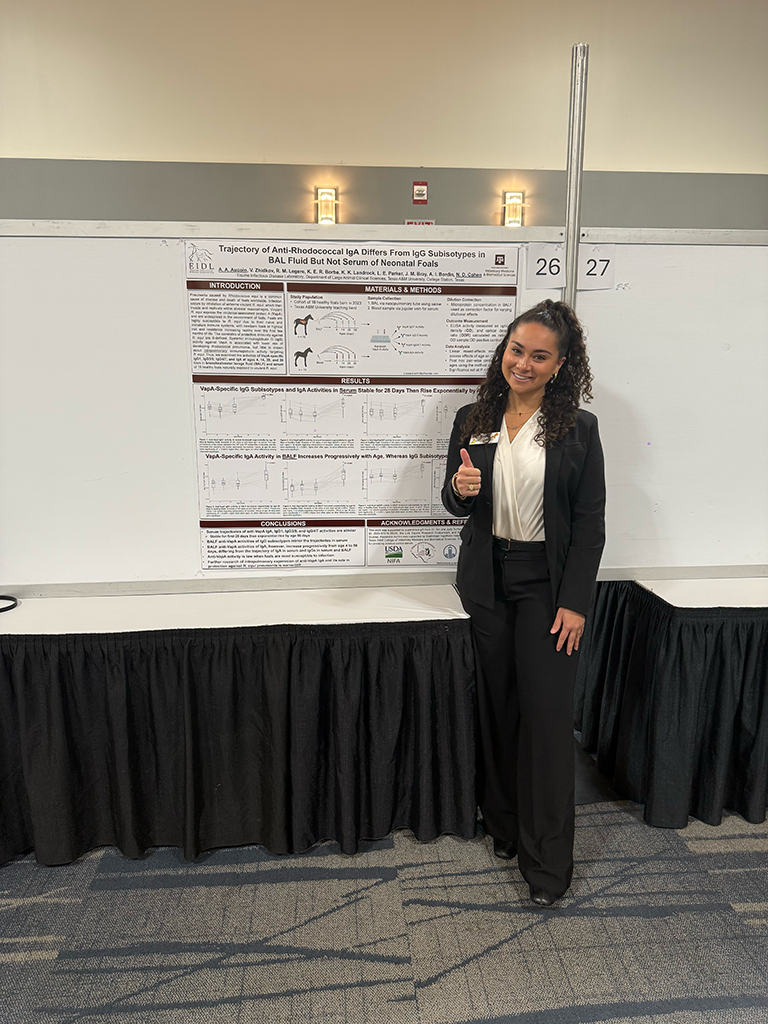
Aucoin presents her research.
While Texas A&M was one of Aucoin’s top choices for her undergraduate degree, it was always her dream to attend Cornell University for veterinary school.
“I’m from the East Coast, so that was the school I’d dreamed of going to for my DVM,” she said. “But after I applied to five veterinary schools and got into all five, I had a hard time deciding which one to choose.”
In the end, Aucoin researched a handful of current equine veterinarians from across the country with careers she admired.
“All of them had connections to Texas A&M,” she said. “I realized that all roads were leading back here.”
Once in the DVM program, Aucoin learned about the VMSRTP, which encourages veterinary students to explore scientific research.
“I’m getting closer to finishing my DVM and I was looking for something that would challenge me,” Aucoin said. “I already knew Dr. Cohen — who is the director of EIDL — and about his research project to find a vaccine for Rhodococcus equi, a bacteria that causes severe pneumonia in foals, so I decided to do my project there.”
For her project, Aucoin examined antibodies in samples from a group of foals that were naturally exposed to R. equi but did not develop pneumonia to understand what helped these foals stay healthy.
“Foals are naturally exposed to the bacteria through air, soil, and feces, and they often become infected shortly after birth, when their immune systems are most vulnerable,” Aucoin said. “I was able to see real evidence that foal antibody production is lowest when they need it most — during the first few weeks of life. That’s why we need a vaccine to help them.
“I also found that there were higher levels of certain antibodies in the foals’ lungs, which might be evidence that there are lung immune cells that can help protect foals,” she said. “It’s a new idea that some researchers are starting to suggest. Historically, we’ve always thought that the blood has to deliver antibodies to the lungs, so if the lungs can provide their own antibodies, that would be good news.”
Student Research Making A Difference
While Aucoin’s research is just a single part of the mission to find a vaccine for foal pneumonia, she’s excited to have made a contribution to a project with such immense real-world value.
“Dr. Cohen is always reminding us that research should have a clinical application,” Aucoin said.
One of the things that stood out the most from her experience was the mentorship she received from Cohen and Dr. Angela Bordin, an assistant professor of immunology and infectious diseases at the EIDL.
“I remember feeling so intimidated at the first lab meeting I went to, knowing I was surrounded by some of the smartest people on earth,” she said. “But they never considered me just a veterinary student. They made me feel capable and showed me that even as a veterinary student, I can contribute to real research.”
Aucoin was also impressed with the VMSRTP itself, which encouraged her to make research a part of her veterinary education.
“Dr. Dana Gaddy and Dr. Tracy Vemulapalli make the program very beginner-friendly,” Aucoin said. “I’m a very type-A person, so I loved that they set up the timeline for you and tell you exactly how the program works. “It ended up being one of the best decisions I ever made,” she said.
This story by Courtney Price originally appeared on VMBS News.